Written By Ben Malena 💥 CMO AlgoPear Edition 37
Retail trading is no longer a niche activity reserved for a small subset of market participants. It has become a permanent fixture of modern financial behavior. Individuals across age groups, income levels, and experience tiers are engaging markets with a frequency and confidence that would have been difficult to imagine a decade ago. Trading is no longer episodic or event-driven — it is continuous, habitual, and culturally normalized.
This surge spans far beyond equities alone. Retail participation now extends across ETFs, options, digital assets, and alternative instruments, reflecting a broad-based shift rather than a single-asset phenomenon. Access to these markets has expanded dramatically, removing structural barriers that once limited who could participate and how often. Markets that were previously gated by capital, expertise, or institutional relationships are now open by default.
Culturally, investing has moved from the background into everyday discourse. Market movements, strategies, and asset classes are discussed openly across social platforms, media, and peer groups. Financial participation has become social and iterative, reinforcing engagement through shared narratives and collective learning rather than private decision-making alone.
What distinguishes this period from past retail surges is persistence. Participation remains elevated across volatility cycles, macro uncertainty, and market corrections. Retail trading is no longer reacting to conditions — it is embedded within them.
At the foundation of this shift is a transformation in access. The friction that once defined retail participation — commissions, delays, minimums, and opaque pricing — has largely disappeared. Trading has become frictionless, immediate, and intuitive, allowing individuals to engage markets with unprecedented ease.
Speed has amplified this transformation. Real-time pricing, instant execution, and constant visibility have altered how individuals interact with markets. Decisions are no longer deferred or deliberated over long periods; they are made dynamically, informed by continuous feedback. Markets feel responsive and alive, encouraging repeated interaction.
Information availability has reinforced this behavior. Tools, analytics, commentary, and educational resources that were once reserved for professionals are now broadly accessible. Individuals are no longer passive recipients of market information — they actively interpret, test, and refine their understanding through participation.
Together, access, speed, and information have created an environment where engagement feels natural rather than exceptional. Retail traders are not “entering” markets — they are living inside them.
The rise in retail trading is not purely behavioral — it is economic. Wage growth has struggled to keep pace with rising costs of housing, education, healthcare, and retirement. For many individuals, traditional saving no longer feels sufficient to achieve financial progress. Market participation has become a rational response to structural pressure.
This reality has reshaped attitudes toward risk. Rather than viewing trading as speculative, many individuals see it as necessary. Capital preservation alone no longer guarantees security. Growth is required, and markets offer one of the few accessible paths toward it.
At the same time, trust dynamics have shifted. Individuals are less inclined to fully outsource financial decision-making to traditional gatekeepers. Autonomy — the ability to learn, decide, and act independently — has become central to financial confidence. Trading enables that autonomy in real time.
This helps explain why participation persists through volatility. Fluctuation is no longer a deterrent; it is an accepted feature of engagement. Markets are not avoided during uncertainty — they are navigated.
Trading apps did not rise simply because they were convenient — they rose because they fundamentally changed how individuals experience financial markets. What was once abstract, delayed, and intimidating became immediate, visual, and interactive. Trading moved from desktop platforms and brokerage calls to mobile interfaces, notifications, and real-time feedback. This shift didn’t just lower barriers; it rewired expectations.
These platforms reframed trading as a daily behavior rather than a periodic event. Markets became something users checked instinctively, integrated into daily routines alongside communication and media. Over time, trading apps stopped feeling like tools and started functioning like environments — places where attention, learning, and decision-making converged.
Critically, trading apps collapsed the distance between education and action. Users could learn, observe, discuss, and execute in the same moment. This proximity accelerated confidence and normalized experimentation. Financial literacy was no longer theoretical — it was experiential.
As adoption scaled, these platforms evolved into financial infrastructure. They became the primary interface through which millions of individuals formed opinions about markets, risk, and opportunity. In doing so, they began shaping financial identity itself.
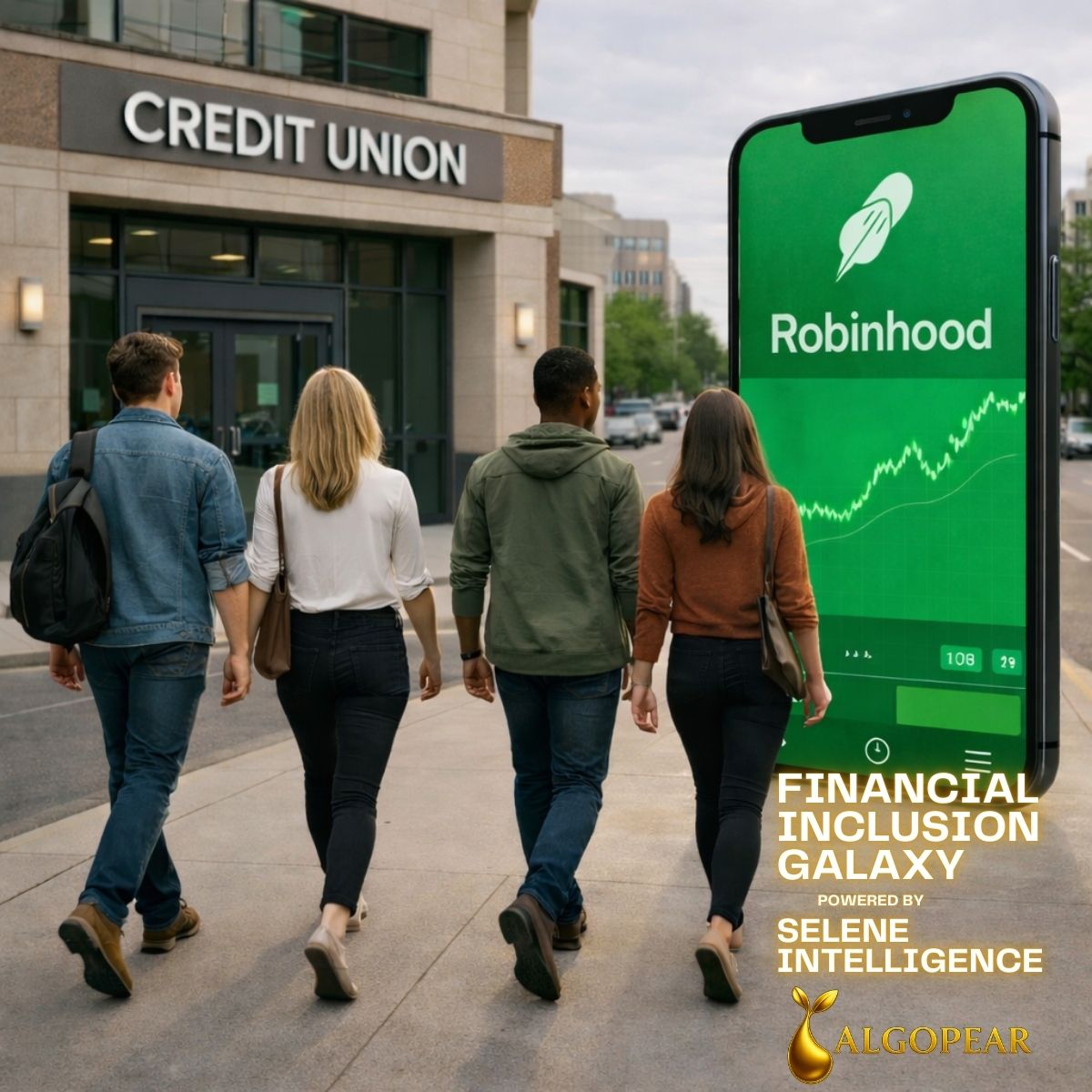
As retail trading has become normalized, credit union members have begun to reassess what they expect from their primary financial institution. Investing is no longer viewed as a specialized activity reserved for external platforms or later stages of life. It is increasingly seen as a core component of financial well-being. Members now assume that the institution holding their deposits should also support their ability to participate in markets and build long-term wealth.
This demand spans demographics and life stages. Younger members expect access by default, while older members are actively managing retirement risk, reallocating assets, and seeking yield in a changing economic environment. Across the spectrum, members are already investing — just not always through their credit union. That disconnect is becoming more apparent as market participation becomes routine rather than exceptional.
When investment activity occurs elsewhere, members begin to notice the fragmentation in their financial lives. Checking and savings live in one place. Growth lives in another. Education lives somewhere else entirely. Over time, the institution that supports growth becomes the institution members associate with progress and financial confidence, even if their primary accounts remain behind.
This shift places pressure on credit unions in a subtle but powerful way. Members are not asking for speculative access or niche products. They are asking for participation — the ability to engage markets, learn, and grow within the same institution they already trust. As retail trading continues to rise, this expectation will only intensify.
The sustained rise of retail trading is not a market anomaly — it is a structural signal. Individuals no longer accept a passive role in financial systems. They expect participation, transparency, and agency. Trading has become one expression of a broader shift toward active financial engagement.
This shift challenges traditional assumptions about where influence resides. Custody alone no longer defines relevance. Engagement does. The institutions and platforms that facilitate participation increasingly shape expectations, behavior, and loyalty.
Retail trading also reflects a deeper cultural evolution. Financial literacy is no longer deferred or optional. It is integrated into daily life and reinforced through action rather than instruction. Markets have become learning environments as much as financial ones.
Taken together, these forces suggest that retail trading is not something the system will “cool off.” It is something the system must absorb. Participation has become embedded in how people relate to money — and once embedded, it reshapes expectations for every financial institution that hopes to remain relevant.
Visit our website Www.AlgoPear.com 🔗
.png)

.jpg)

.jpg)