Written By: Ben Malena 💥 CMO AlgoPear Edition 31
For years, banks treated digital assets and embedded investing as optional — a far-off experiment that didn’t affect their core business. But that era is gone. The same institutions that once dismissed these services are now racing to deploy them. And they’re not doing it quietly. They’re moving fast because the market forced their hand. Fintech giants like Robinhood, Coinbase, and Cash App didn’t just introduce new financial tools; they changed member behavior at scale. They taught consumers that investing should be simple, instant, mobile, and woven directly into everyday financial life. And now that consumers expect this level of access, banks have no choice but to match it.
It’s the full arrival of the Fourth Industrial Revolution inside financial services — where intelligence, automation, digital assets, and real-time decision-making converge into a single ecosystem. For community FIs, this marks a defining moment. The fintechs changed member expectations. The big banks have adapted to those expectations. The only question left is whether community FIs will evolve with them or risk becoming irrelevant to the next generation of members.
And here’s the part most community leaders are only starting to realize: once the biggest institutions validate digital assets and embedded investing, those services stop being “innovations” and become “expectations.” The bar doesn’t rise slowly — it rises instantly. Members don’t care that Banks A, B, or C have billion-dollar tech budgets; they simply assume their financial institution — big or small — should offer the same modern tools. That’s why the switch flipping at the top of the industry is so consequential: it reshapes what every member will expect everywhere else.
The shift we’re watching didn’t start inside the banks — it started on the edges, with platforms bold enough to break every rule the industry thought was fixed. Robinhood eliminated friction and made investing feel as natural as scrolling social media. Coinbase turned digital assets from a niche concept into a mainstream gateway. Cash App blurred the boundaries between payments, banking, and wealth-building. These weren’t incremental improvements; they were entirely new experiences that taught consumers something legacy institutions never anticipated: that managing wealth could be intuitive, immediate, and always within reach.
Once consumers internalized this new standard, the traditional banking experience began to feel outdated almost overnight. Fintechs showed members that financial tools didn’t need branches, paperwork, or long onboarding processes. They proved that investing didn’t need to be intimidating, and digital assets didn’t need to be mysterious. The result was a fundamental rewiring of consumer expectations — and those expectations became the new baseline against which every financial institution is now judged.
This is the part that caught big banks off guard. Fintechs didn’t steal customers by offering higher interest rates or better branding. They won because they built experiences aligned with how people already make decisions in the digital age. When consumers realized they could invest with a few taps, track their money in real time, and access modern asset classes instantly, traditional channels lost their grip. And once behaviors shift at scale, institutions don’t get to decide whether to participate — they either adapt or fall behind.
Fintechs forced the industry’s hand by proving that the member relationship is no longer anchored by the branch, the checking account, or even the brand name. It’s anchored by utility, speed, intelligence, and access. It’s anchored by experiences that feel alive, not static. And as fintech adoption surged, banks eventually recognized what community FIs must now accept as well: the financial landscape isn’t being disrupted — it has already been rebuilt.
The biggest surprise in this new era is not that fintechs led the way — it’s that incumbent banks are now becoming the first major movers in embedded investing and digital asset access. Institutions like Citi, Bank of America, JPMorgan Chase, U.S. Bank, and others have begun rolling out modern investment tools directly inside their digital banking ecosystems. The same banks that once treated digital assets as speculative or “out of scope” are now actively building pathways for members to buy, learn, and engage with new asset classes in a compliant, user-friendly format. Their rapid shift marks one of the clearest signals that traditional finance has fully entered a new competitive cycle.
These banks aren’t taking small steps, either. They are embedding investment capabilities into mobile experiences that used to offer little more than transfers and bill pay. Citi and Bank of America are expanding their internal infrastructure for member-facing investment tools. U.S. Bank has started integrating digital asset education and custody solutions. Chase is exploring tokenized products and programmable money rails. All of these moves point in one direction: the largest financial institutions in the country are now treating embedded investing and digital assets as essential services — not experiments.
What makes this significant is that incumbent banks are validating what fintechs proved at scale: members want access to modern investment products directly inside the platforms they already use. Once a Citi or a Bank of America integrates these services, they normalize them. They establish the expectation that any institution — regardless of size — should offer a similar experience. This instantly shifts consumer perception of what a “complete” financial relationship looks like, and it raises the bar for everyone else in the industry.
For community FIs, this moment represents a turning point. When the largest banks in the world commit to embedded investing and digital assets, the rest of the industry must respond or risk being left behind. Members will not differentiate between what a trillion-dollar bank can deliver and what their local institution “should” deliver. They will simply expect the same level of access everywhere. Incumbent banks moving first doesn’t just signal a trend — it creates a new competitive reality that every credit union and community bank must prepare to meet.
Fintechs didn’t just introduce new financial tools — they reshaped how people expect to interact with their money. Robinhood gave consumers instant access to markets. Coinbase made digital assets accessible in a few taps. Cash App blurred the lines between banking, payments, and investing. These platforms taught members that financial activity should be fast, intuitive, and always available. Once people experienced that kind of immediacy, the traditional banking model felt slow and disconnected.
What fintechs really disrupted wasn’t banking itself — it was the rhythm of financial decision-making. Members became accustomed to seeing real-time data, executing investments instantly, and learning through simple in-app experiences. They started expecting their financial tools to meet them where they already are, rather than forcing them through outdated processes. Fintechs didn’t win because they were cheaper; they won because they aligned perfectly with modern digital behavior.
This shift had a domino effect that banks could no longer ignore. As millions of consumers developed financial habits inside fintech apps, traditional institutions saw deposits drifting, engagement declining, and younger generations bypassing them entirely. The member relationship moved from being anchored in a checking account to being anchored in the digital experience. And once fintechs set that new standard, they effectively rewrote the rules for the entire financial industry.
For community FIs, the impact is unavoidable. Members now expect their financial institution — no matter how large or small — to offer the same type of seamless, embedded, modern tools they see elsewhere. It doesn’t matter that fintechs and big banks have massive budgets; consumers assume everyone operates with the same capabilities. That expectation gap is the biggest challenge facing credit unions today, and it is the reason why early adoption of modern investing and digital assets is becoming essential rather than optional.
All signs point to 2026 becoming the biggest year ever for direct investing adoption across the financial industry. The momentum that began with fintechs, and was later validated by the largest U.S. banks, is now accelerating into a full-market shift. Consumers have crossed a threshold where investing is no longer a specialized activity for a small percentage of households — it has become an everyday expectation. Digital assets are gaining regulatory clarity, embedded investing is becoming a baseline feature inside mobile banking, and younger generations are entering their peak earning years with entirely different financial habits than the generations before them.
For community FIs, this means a wave is coming — one large enough to redefine how members engage with their financial institution. The institutions that embrace embedded investing early will see record-breaking engagement, deeper digital adoption, and a surge in new use cases as members begin relying on their FI not just to hold money, but to help them grow it. The institutions that wait will find themselves trying to catch up to a behavioral shift that’s already locked in by the time they enter the market.
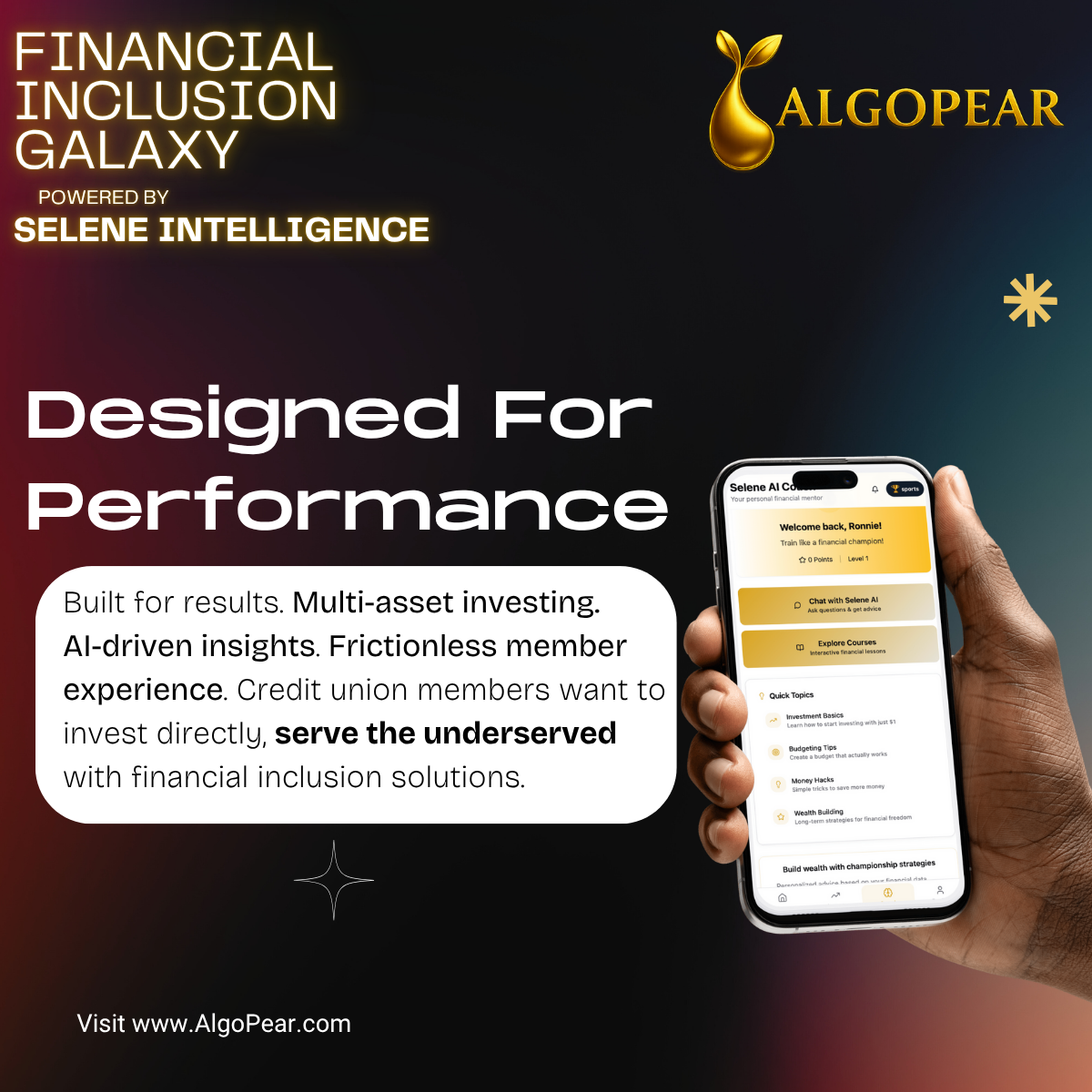
This is where Selene Intelligence by AlgoPear becomes transformative. As investment adoption accelerates, the institutions with real-time insights, guided financial intelligence, and seamless embedded investing will capture the majority of the growth. Selene allows community FIs to move at the pace of the market, not the pace of legacy tech infrastructure. It gives your members the tools they expect going into 2026 — personalized recommendations, automated investing pathways, digital asset education, and dynamic financial insights — all inside an experience that feels natural, modern, and built for them.
The financial industry is about to experience its strongest shift in member behavior since mobile banking went mainstream. 2026 won’t just be another year — it will be the year embedded investing becomes the norm, not the exception. And the FIs that align with this moment will secure their place in the next era of community finance.
Selene Intelligence is your bridge into that future — and 2026 is the year to cross it.
👉 algopear.com
.jpg)

.jpg)